
With increasing drone activity reported around major hubs like Suvarnabhumi Airport, the Thai government is urging the public to "Observe, Record, and Report" suspicious sightings. But identifying a small light miles away in the dark can be challenging.
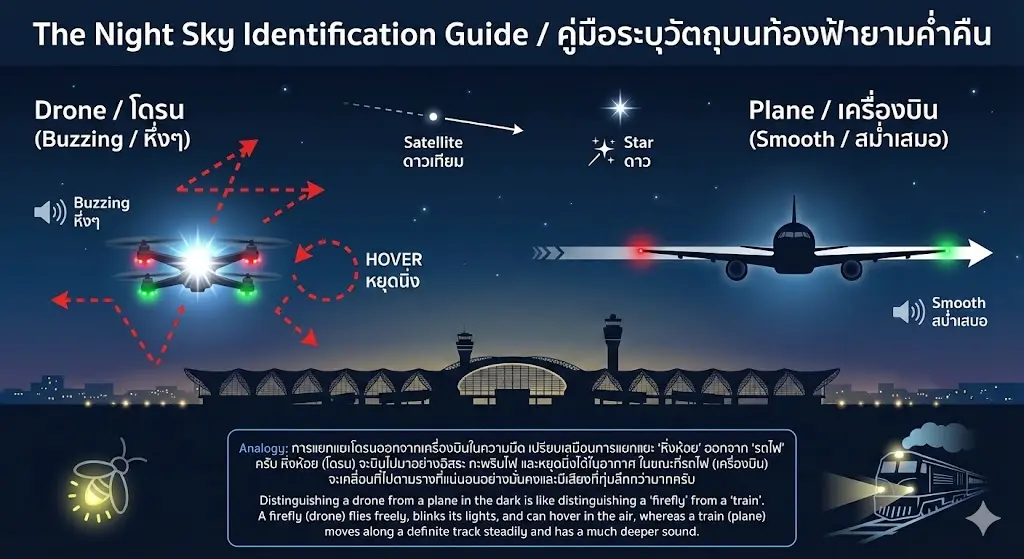
Here are the key clues to help you tell the difference:
1. Watch the Light Patterns 💡
- Drones: Feature tightly clustered lights close to the airframe, typically with red on the port (left) and green on the starboard (right) sides. They often have a bright white strobe (anti-collision light) pulsing at regular intervals, visible for at least 3 miles (~ 5 kilometers).
- Planes: Have lights spread far apart on the wingtips and tail. They move in a broad, steady signature across the sky.
2. Track the Movement ✈️
- Drones: Known for their erratic or precise movement. They can hover in place, pivot 90 degrees on a dime, or reverse course instantly.
- Aircraft, Satellites & Stars: Aircraft and satellites glide silently in a straight line with a steady white light. Stars remain fixed relative to the horizon and twinkle due to atmospheric interference.
3. Listen for the Acoustic Signature 🔊
- Drones: Emit a high-pitched buzzing or whirring noise. This sound usually fades beyond a few hundred feet.
- Manned Aircraft: Planes produce deep jet engine roars, while helicopters create a distinctive "thumping" rotor sound that carries over long distances.
What to Do If You Spot a Suspicious Drone? 📞
In high-risk areas like airport no-fly zones, follow these three steps:
- Observe: Use the app, such as Flightradar24, to check for registered aircraft. If the object isn't on the app, it might be a drone.
- Record: Take a steady video for at least one minute to capture its flight pattern and light colors.
- Report: Call emergency services at or contact the related authority.