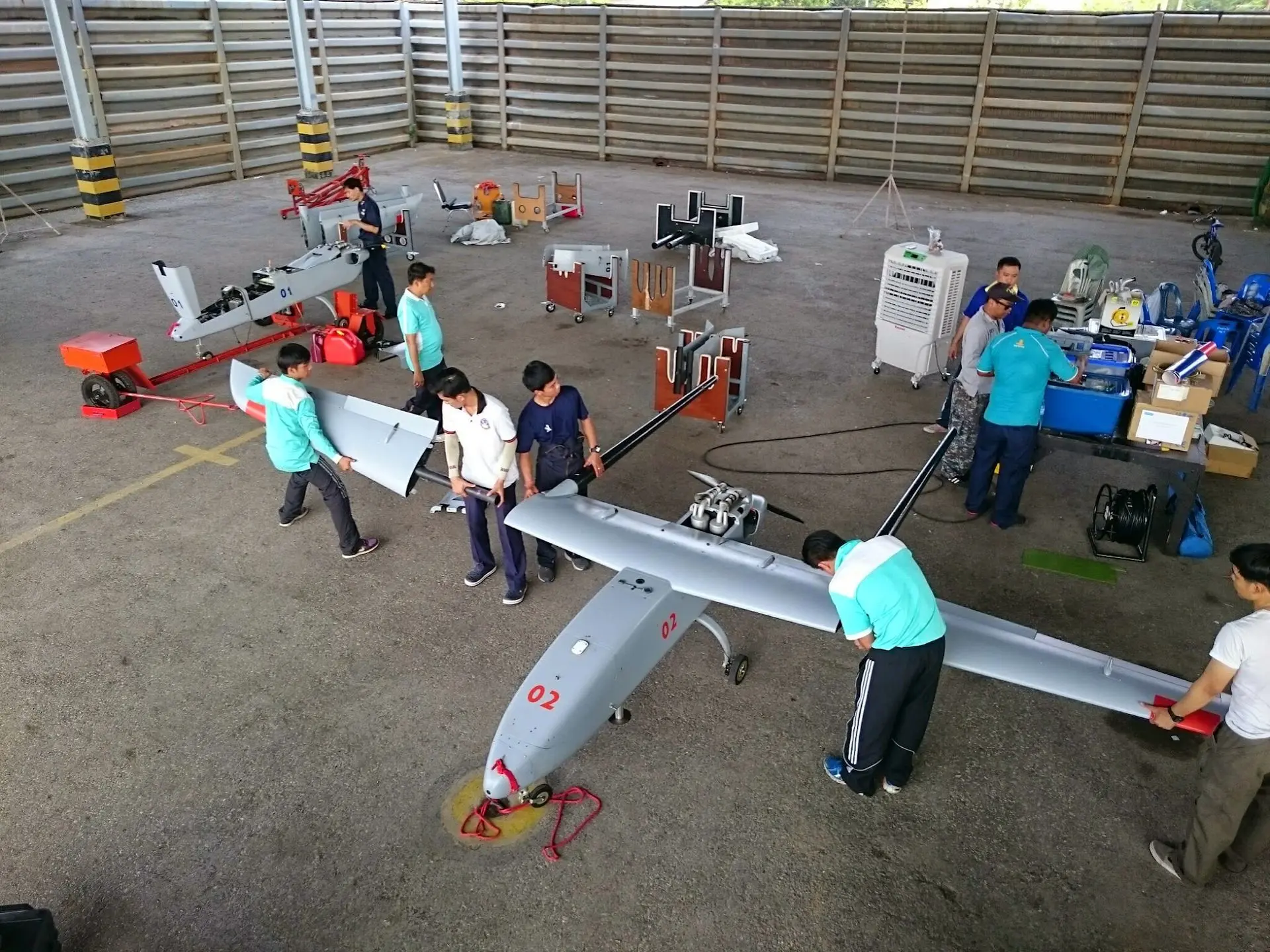
In the pursuit of national defense self-reliance, the Royal Thai Air Force (RTAF) launched a landmark initiative in 2014 to develop a high-performance tactical UAV. As a leader in high-tech shipbuilding and composite structures, Marsun stepped forward as the prime contact and structural lead for this ambitious project.
By bridging the gap between existing aerospace concepts and rigorous military requirements, Marsun, alongside our engineering partner HiveGround, successfully delivered a sovereign Thai solution: the Tigershark II Type 3.
A Legacy of Local Evolution
The development of the Tigershark II was a journey of continuous improvement and localization:
- Airframe 01: The initial prototype airframe was originally developed by G-Force Composites, providing the foundation for early testing and systems integration.
- Airframe 02: Building on the lessons learned from the first prototype, the second airframe was developed by another local Thai company, furthering the RTAF’s goal of domestic technological independence.
- Marsun’s Integration: Marsun oversaw the structural transition and airworthiness refinements, ensuring that the local airframes met the grueling demands of tactical operations.
Precision Engineering with HiveGround
While Marsun managed the structural integrity and project lifecycle, HiveGround served as the critical brain-trust for robotics and avionics.
- Avionics & Control: HiveGround integrated the Piccolo II autopilot and EnerLink III data links, creating a seamless interface between the aircraft and the ground control station.
- Mission Systems: The platform was equipped with the TASE300 gimbal, allowing for high-definition reconnaissance and tactical intelligence gathering.
- Software Synchronization: HiveGround integrated the complex control systems required for autonomous flight, enabling the transition from manual RC control to full autopilot mission profiles.
Milestone: The 100 km Range Test
The project reached a historic peak on April 7, 2015, at the Watthana Nakhon (VTBW) airfield. The Tigershark II No. 02 successfully completed a 100 km Range Test, proving the platform's ability to handle long-distance tactical missions.
Flight Validation: The landing path and mission logs were meticulously verified using EnerLink data, confirming that the aircraft could adhere to precise flight corridors.
Standardization: The team achieved significant compliance with STANAG 4671 (NATO Airworthiness Standards), a critical step for modern military aviation.
Continuous Refinement for Operational Excellence
A project of this scale requires relentless attention to detail. Marsun and HiveGround identified and implemented numerous technical upgrades during the development of Airframe 02 such as:
Enhanced Safety: We replaced standard RC valves with dedicated hydraulic brake valves to handle the intense vibrations of military flight.
Structural Durability: We standardized components like throttle levers and fuel tank seals, moving away from "freehand" modifications to industrial-grade aerospace parts.
Engine Stability: We upgraded the muffler supporters to high-heat PTEF materials, protecting the powerplant during extended missions.
Mission Success
The Tigershark II project concluded as a resounding success, fulfilling the RTAF’s operational requirements and meeting the strict conditions of the development contract. Today, this project serves as a blueprint for how Thai companies—from shipbuilders to roboticists—can collaborate to protect the nation's skies.